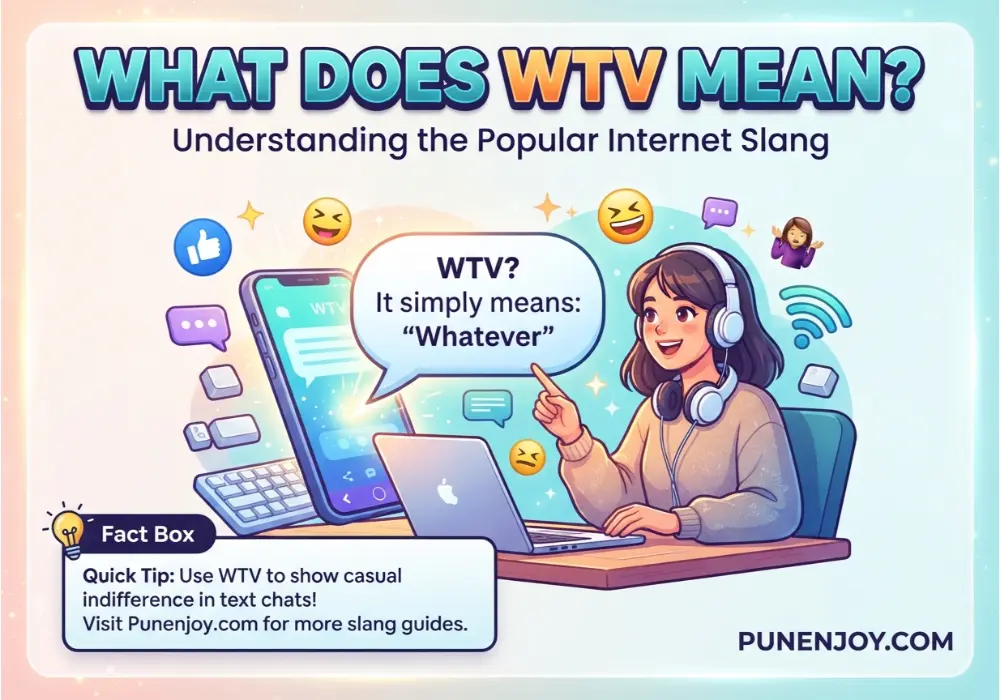
If you have seen someone type “wtv” in a text message, comment, or social media chat, you may have wondered, “What is wtv mean?” In most online conversations, wtv means “whatever.” It is a short form people use when they want to save time while texting.
You may see wtv on WhatsApp, Instagram, TikTok, Snapchat, Discord, and other messaging platforms. Depending on the conversation, it can sound casual, relaxed, playful, or slightly dismissive. The meaning often depends on the words around it and the tone between the people chatting.
What Does WTV Mean in Text & Chat?
In text messages and online chats, WTV usually means “whatever.” It is an abbreviation created by shortening the word to a few letters. Like many internet slang terms, it is mainly used because it is quick and easy to type.
For example, instead of writing:
“Whatever, it is fine.”
Someone might simply write:
“Wtv, it’s fine.”
The exact feeling behind wtv can change from one conversation to another. Sometimes it is completely neutral. A person may use it because they do not care which option is selected. In other situations, it can show annoyance or that someone does not want to continue an argument.
Common meanings of WTV
- WTV = Whatever
- WTV = It doesn’t matter
- WTV = Any option is fine
- WTV = I don’t really care
- WTV = Let’s move on
For example:
Person A: “Do you want pizza or burgers?”
Person B: “Wtv, you choose 😂”
Here, wtv is relaxed and means the person is happy with either choice.
But consider another example:
Person A: “You never listen to me.”
Person B: “Wtv.”
Here, it may sound more dismissive. The short reply can suggest that the person does not want to argue.
The key point is that wtv meaning in text depends on context. The same abbreviation can sound friendly in one conversation and cold in another.
Full Form, Stands For & Short Meaning of WTV
The most common WTV full form is “whatever.” It is not normally an acronym where every letter represents a separate word. Instead, it is simply a shortened texting form of whatever.
WTV stands for:
WTV = Whatever
The abbreviation is especially useful in casual digital communication. Texting often encourages people to shorten common words. Examples include:
- BTW = By the way
- IDK = I don’t know
- TBH = To be honest
- IMO = In my opinion
- WTV = Whatever
When someone asks, “What does WTV stand for?”, the safest answer is “whatever.”
WTV meaning in simple English
The easiest way to understand it is:
WTV = Whatever / It doesn’t matter / You decide
However, you should not assume that every person means exactly the same thing. Tone matters.
For instance:
“Wtv, I’m okay with either movie.”
This sounds neutral.
“Wtv. I’m done talking.”
This sounds more annoyed or dismissive.
The punctuation can also affect the tone. Compare:
- “wtv 😂” → casual or playful
- “wtv lol” → relaxed
- “wtv…” → possibly annoyed or uninterested
- “WTV.” → may sound firm or dismissive
Therefore, WTV does not automatically mean someone is angry. You need to consider the entire conversation.
For more texting abbreviations, you can internally link this page to related articles such as [IDK Meaning in Text], [BTW Meaning in Text], [TBH Meaning in Text], and [IMO Meaning in Text].
Origin, History & First Known Use of WTV
The exact moment when wtv first appeared in online communication is difficult to identify. Internet slang rarely has one official inventor or a single confirmed starting date. Instead, abbreviations develop naturally as people look for faster ways to communicate.
The word “whatever” itself is much older than internet slang. English speakers have used it for a very long time to refer to anything or to express indifference. The shortened form wtv belongs to the much newer world of digital communication.
As texting, instant messaging, forums, and social media became popular, users began shortening familiar expressions. Typing wtv takes less effort than typing whatever, especially on mobile devices.
Similar patterns created many other popular abbreviations:
- “you” → u
- “are” → r
- “because” → bc
- “please” → pls
- “whatever” → wtv
Early internet communities helped spread shortened language, and mobile texting made these forms even more convenient.
There is no universally accepted date that can be called the first known use of WTV. Slang changes quickly, and many early online conversations were not preserved or indexed.
Today, WTV is best understood as a casual internet and texting abbreviation, rather than formal English.
It is also important to remember that slang evolves. A term can become popular, fade for a while, and then appear again on a different platform. The meaning can also shift slightly depending on the community using it.
In 2026, wtv still appears in casual digital conversations, although people may choose other expressions depending on their age, platform, and personal texting style.
How People Use WTV in Daily Conversations
People use wtv in everyday chats mainly to express indifference, flexibility, or a desire to stop discussing something.
One common use is when someone does not have a preference.
Example:
Friend: “Should we meet at 5 or 6?”
You: “Wtv works for me 👍”
Here, WTV means that either option is acceptable.
Another use is when someone wants to show that a small issue is not important.
Friend: “Sorry, I picked the wrong restaurant.”
You: “Wtv, we can still have fun.”
In this case, the abbreviation can make the response sound relaxed.
However, WTV can also be used when someone feels frustrated.
Person A: “You keep changing your story.”
Person B: “Wtv.”
This version may suggest, “I don’t want to discuss this anymore.”
Quick examples
- “Wtv you want.” → You can choose.
- “Wtv, it’s fine.” → It doesn’t matter.
- “I’ll watch wtv you pick.” → Any choice is okay.
- “Wtv 😂 forget it.” → Casual or playful dismissal.
- “Wtv, I’m not arguing.” → The speaker wants to end the discussion.
Because WTV is informal, it is usually better suited to friends, family, casual chats, comments, and social media.
It would not normally be appropriate in a formal school email, job application, business letter, or professional message.
WTV Meaning Across WhatsApp, Instagram, TikTok & Snapchat
The basic meaning of wtv remains “whatever” across most major social platforms. However, the tone can change depending on the platform and the type of conversation.
WTV on WhatsApp
On WhatsApp, people often use WTV with friends or family.
“Wtv, just let me know when you’re free.”
This usually means the person is flexible.
WTV on Instagram
On Instagram, WTV may appear in comments, direct messages, captions, or replies.
For example:
“Wtv 😂 I still like the first one.”
The emoji helps make the message feel less serious.
WTV on TikTok
TikTok users may use WTV in comments or messages as a quick reaction.
“Wtv, this video still made me laugh 😭.”
Here it can express playful indifference.
WTV on Snapchat
Snapchat conversations are usually fast and informal, making short abbreviations useful.
“Wtv, send me the pic later.”
Again, it generally means “whatever” or “it’s fine.”
Does WTV have a different meaning on each platform?
Usually, no. WTV does not suddenly have a completely different standard meaning on WhatsApp, Instagram, TikTok, or Snapchat.
The biggest difference is tone.
A person writing “wtv 😂” may be joking. Someone writing “WTV.” may sound irritated.
So when interpreting wtv meaning on social media, look at:
- The previous messages
- Punctuation
- Emojis
- The relationship between the people
- The topic of the conversation
- The person’s normal texting style
Different Meanings of WTV in Other Fields
Although “whatever” is by far the most common meaning of WTV in texting, abbreviations can have different meanings in specialized fields.
This is why context matters.
In casual online communication, someone saying:
“WTV, you choose.”
almost certainly means “whatever.”
But in a technical, professional, academic, or organizational setting, WTV could potentially represent a name, abbreviation, code, organization, location, or specialized term.
For example, a three-letter abbreviation can be reused by completely different industries. The meaning of an abbreviation should therefore be determined by the subject being discussed.
Important distinction
If you see WTV in a text message, the intended meaning is normally:
Whatever
If you see WTV in a technical document, do not automatically assume it means “whatever.” Check the surrounding information.
This distinction is useful because many abbreviations have multiple meanings.
For example, “PC” can mean personal computer, politically correct, or other things depending on context. Likewise, “ID” can refer to identification or an identifier.
WTV is similar in that its interpretation depends on where you encounter it.
For SEO and search intent, most people searching “what is WTV mean,” “WTV meaning in text,” or “what does WTV stand for” are asking about texting slang. Therefore, whatever is the relevant meaning for everyday chat.
Common Confusions, Mistakes & Wrong Interpretations
One common mistake is assuming that wtv always sounds rude. That is not true.
WTV can be neutral, friendly, playful, or dismissive.
Consider these examples:
“Wtv you want to eat 😊”
This sounds flexible.
“Wtv. Do what you want.”
This may sound annoyed.
Another mistake is assuming that WTV is a formal abbreviation. It is not. It belongs mainly to casual digital communication.
Common misunderstandings
1. Thinking WTV always means “I don’t care.”
It can mean that, but it can also mean “either choice is fine.”
2. Assuming the sender is angry.
Short messages can look cold even when the sender is not upset.
3. Using WTV in formal writing.
It is better to write “whatever” in professional or academic communication.
4. Confusing WTV with another abbreviation.
Some people may not recognize it immediately, especially if they do not use internet slang often.
5. Reading too much into punctuation.
“Wtv 😂” and “WTV.” may feel different, but you should consider the full conversation before deciding what the sender intended.
A simple rule
If you are unsure what someone means by WTV, look at the sentence around it.
For example:
“Wtv you want” → likely means “choose whatever you want.”
“Wtv, I’m done” → likely expresses dismissal.
Understanding the surrounding message is more reliable than treating the abbreviation as having one fixed emotional meaning.
Similar Terms, Alternatives & Related Slang
There are several expressions that can communicate a similar idea to wtv.
Common alternatives
- Whatever — the complete word
- IDC — I don’t care
- IDK — I don’t know
- Up to you — you can decide
- Either is fine — both options are acceptable
- Doesn’t matter — no strong preference
- I don’t mind — either option is okay
- Your choice — you decide
However, these expressions are not exact synonyms.
For example:
“IDC” usually means “I don’t care.”
“WTV” can mean “whatever,” but it may simply indicate that the speaker is flexible.
Compare:
“Where should we eat?”
“Wtv, you choose.”
This sounds like flexibility.
But:
“Do you even care about this?”
“IDC.”
This sounds more direct.
Other popular slang terms can also appear alongside WTV:
- LOL — laughing out loud
- LMAO — laughing very hard
- FR — for real
- NGL — not gonna lie
- TBH — to be honest
- BTW — by the way
- RN — right now
- OMW — on my way
For your internal linking strategy, related abbreviation pages could include IDK Meaning, IDC Meaning, FR Meaning, NGL Meaning, TBH Meaning, and BTW Meaning.
Examples of WTV in Real Chat Situations
Seeing WTV in realistic conversations makes the meaning much easier to understand.
Example 1: Choosing food
Friend: “Pizza or tacos?”
You: “Wtv, I’m hungry 😂”
Meaning: Either choice is fine.
Example 2: Choosing a movie
Friend: “Which movie should we watch?”
You: “Wtv you want.”
Meaning: You can choose.
Example 3: Ending an argument
Person A: “I think you’re wrong.”
Person B: “Wtv.”
Meaning: The person does not want to continue the disagreement.
Example 4: Making plans
Friend: “Do you want to go Saturday or Sunday?”
You: “Wtv works for you.”
Meaning: Either day is acceptable.
Example 5: A playful conversation
Friend: “You always pick the weirdest songs.”
You: “Wtv 😂 this one is good!”
Meaning: A playful disagreement.
Example 6: Showing frustration
Person A: “I already told you three times.”
Person B: “Wtv…”
Meaning: The response may show frustration or disinterest.
Quick takeaway
When you see WTV, replace it mentally with “whatever.” Then look at the rest of the message to understand the intended tone.
How to Reply When Someone Says WTV
How you should reply depends on what the sender means.
If they are simply saying that they do not have a preference, you can make the decision yourself.
Them: “Wtv, you pick.”
You: “Okay, let’s get pizza 😄”
If WTV appears during an argument, it may be better not to escalate the situation.
Them: “Wtv.”
You: “No worries. We can talk about it later.”
If the message sounds playful, you can respond in the same tone.
Them: “Wtv 😂”
You: “You know I’m right though 😂”
Possible replies
- “Okay, sounds good!”
- “Cool, I’ll choose.”
- “No worries 😊”
- “Haha, fair enough.”
- “Alright, your loss 😂”
- “Okay, let’s move on.”
- “Do you mean either option is fine?”
The last response is useful when you genuinely cannot tell what the person means.
For example:
Them: “Wtv.”
You can say:
“You mean you don’t mind, or are you annoyed?”
This can prevent a small misunderstanding from becoming a bigger one.
Remember that WTV can sometimes sound dismissive, so avoid responding aggressively unless the context clearly calls for it.
Is WTV Still Popular? Trends & Online Usage
Yes, WTV is still recognizable and used in casual online communication in 2026, especially in texting and social media conversations. However, internet slang does not stay equally popular forever.
Some abbreviations become extremely common, while others become less fashionable as communication styles change.
WTV has an advantage because it is very easy to understand once you know that it means “whatever.” It is also short, making it useful for quick conversations.
People may use different versions depending on their personal style:
- wtv
- WTV
- Wtv
- wtv lol
- wtv 😂
- whatever
Lowercase writing is common in casual texting because users often type quickly and do not bother with capitalization.
The tone can also be influenced by emojis and punctuation. For example:
“wtv 😂” can feel lighthearted.
“wtv lol” can feel casual.
“WTV.” can feel more serious or dismissive.
This does not mean the punctuation has a fixed dictionary meaning. It simply shows how digital communication uses visual cues to express tone.
In 2026, the safest way to understand WTV remains simple: read the surrounding conversation.
If a friend says “wtv, you choose,” they probably mean that they do not have a preference. If someone replies “wtv” during an argument, they may be trying to end the conversation.
FAQs:
What does WTV mean in texting?
WTV usually means “whatever” in texting. It can express indifference, flexibility, or a desire to stop discussing something.
What is the full form of WTV?
The common full form of WTV is “whatever.” It is a shortened form used mainly in casual digital communication.
Does WTV mean “I don’t care”?
Sometimes. WTV can communicate “I don’t care,” but it can also mean “either option is fine” or “you decide.” Context determines the exact meaning.
Is WTV rude?
Not necessarily. WTV can be completely casual or friendly. However, a short “WTV.” during an argument may sound dismissive or annoyed.
What does WTV mean on WhatsApp?
On WhatsApp, WTV normally means “whatever.” It can be used when someone has no preference or does not want to continue a discussion.
What does WTV mean on TikTok?
On TikTok, WTV generally has the same meaning: “whatever.” It can appear in comments, direct messages, or casual conversations.
Can I use WTV in formal writing?
It is better to avoid WTV in formal writing. Use the complete word “whatever” instead, especially in school, business, or professional communication.
Is WTV still used in 2026?
Yes. WTV remains a recognizable casual texting abbreviation in 2026, although slang preferences vary between people and platforms.
What is the difference between WTV and IDC?
WTV means “whatever,” while IDC means “I don’t care.” They can sometimes communicate a similar idea, but their tone and meaning are not always identical.
Conclusion:
So, what is WTV mean? In most texting and social media conversations, WTV means “whatever.” It is a short, informal way to show that something does not matter, that the other person can choose, or that the speaker does not want to continue a discussion.
The meaning can change slightly depending on the situation. “Wtv, you choose 😂” sounds relaxed, while “WTV.” in the middle of an argument may sound dismissive. That is why context, punctuation, emojis, and the relationship between the people are important.
IWTV remains a useful piece of casual internet slang. If you see it in a message, simply start by reading it as “whatever,” then use the rest of the conversation to understand the speaker’s tone. Once you know this, WTV is pretty easy to understand—and you can confidently use it when a quick “whatever” says it all.

Sergey Sokolov specializes in writing about meaning, definitions, and conceptual understanding. His work aims to break down ideas into simple explanations, helping readers grasp not just what something means, but why it matters. Sergey’s writing combines clarity, logic, and insight.