
Land-based casinos are not disappearing, but the way they are managed is changing quickly.
In 2025, the Philippine gaming industry generated Php396.14 billion in gross gaming revenues, a 6.39% increase from the previous year. The interesting part is not only the growth number. Electronic and online gaming brought in Php201.12 billion, accounting for 50.77% of total industry GGR, while licensed casino revenue declined by 9.58%. In the United States, traditional casino gaming still produced strong monthly numbers. In April 2026, commercial casino table games generated $801.1 million in revenue, according to the American Gaming Association.2025st, land-based casino floors still matter. Table games continue to produce large revenue across regulated gaming markets. Second, physical gaming venues are facing a different type of pressure. They are no longer competing only with nearby casinos. They are also competing with faster, more trackable, more data-driven digital gaming formats.
For table game operators, this creates a practical question: how can a casino keep the atmosphere and trust of live gaming while improving the speed, visibility, and control of daily operations?
That is where a modern casino management system becomes more than a back-office tool. It becomes the operational layer that connects chips, tables, players, dealers, supervisors, cashiers, and management reports into one traceable workflow.
The real challenge is not only running the game
A baccarat table, blackjack table, roulette layout, or VIP gaming room may look simple from the player’s side. The player sees chips, cards, results, and a dealer. The management team sees something much more complex.
Every active table creates multiple layers of information:
- chip buy-ins and redemptions;
- table opening and closing records;
- dealer and supervisor operations;
- game results;
- player activity;
- table limits;
- chip tray movement;
- cash desk settlement;
- shift handover records;
- risk alerts;
- internal audit data.
If these records are handled separately, the casino may still operate, but the management picture becomes delayed. A supervisor may know what happened at one table. The cashier may know what was exchanged. The pit manager may know which table was busy. The finance team may later see the numbers. But if these pieces are not connected in time, the operator is managing yesterday’s information instead of today’s floor.
That delay is where many operational problems begin.
A table game issue is not always caused by a major fraud event or a dramatic mistake. Often, the real cost comes from small gaps: a manual entry delay, a slow handover, a chip count mismatch, an unclear player record, or an abnormal betting pattern that is noticed too late. In a busy casino, even a small delay can create extra work for supervisors, cashiers, compliance teams, and management.
Why real-time control matters more as table games scale
The larger the floor, the more difficult it becomes to manage table games by observation alone.
A small gaming room may rely on experienced staff and manual checks. A larger venue needs a more structured system. Multiple tables, different game types, changing limits, VIP rooms, chip movement, and shift-based staffing all create operational pressure. The problem is not only whether the casino has enough people. The problem is whether those people are working with accurate, timely information.
Real-time operational control gives management a clearer answer to questions such as:
Which tables are active right now?
Where are the chips moving?
Are game records consistent with table activity?
Are player accounts, points, and commission records aligned?
Is there an unusual transaction or betting pattern that needs review?
Can the shift handover be checked without relying only on manual notes?
These are not abstract technology questions. They are everyday casino management questions.
A casino management system helps by turning live table activity into structured operational records. Instead of waiting until the end of a shift to check everything manually, the system can collect and organize key information during the operation itself. That does not remove the need for trained staff. It gives staff better information to work with.
RFID chips change chip management from counting to tracking
Casino chips are not ordinary tokens. They are movable assets with face value, operational meaning, and security importance. Once chips leave the cashier cage and move across tables, players, trays, and settlement points, the casino needs to know more than the total number of chips in circulation. It needs to understand movement.
Traditional chip management depends heavily on manual counting, tray checks, visual inspection, and end-of-shift reconciliation. These procedures are still important, but they can be slow when the floor is busy.
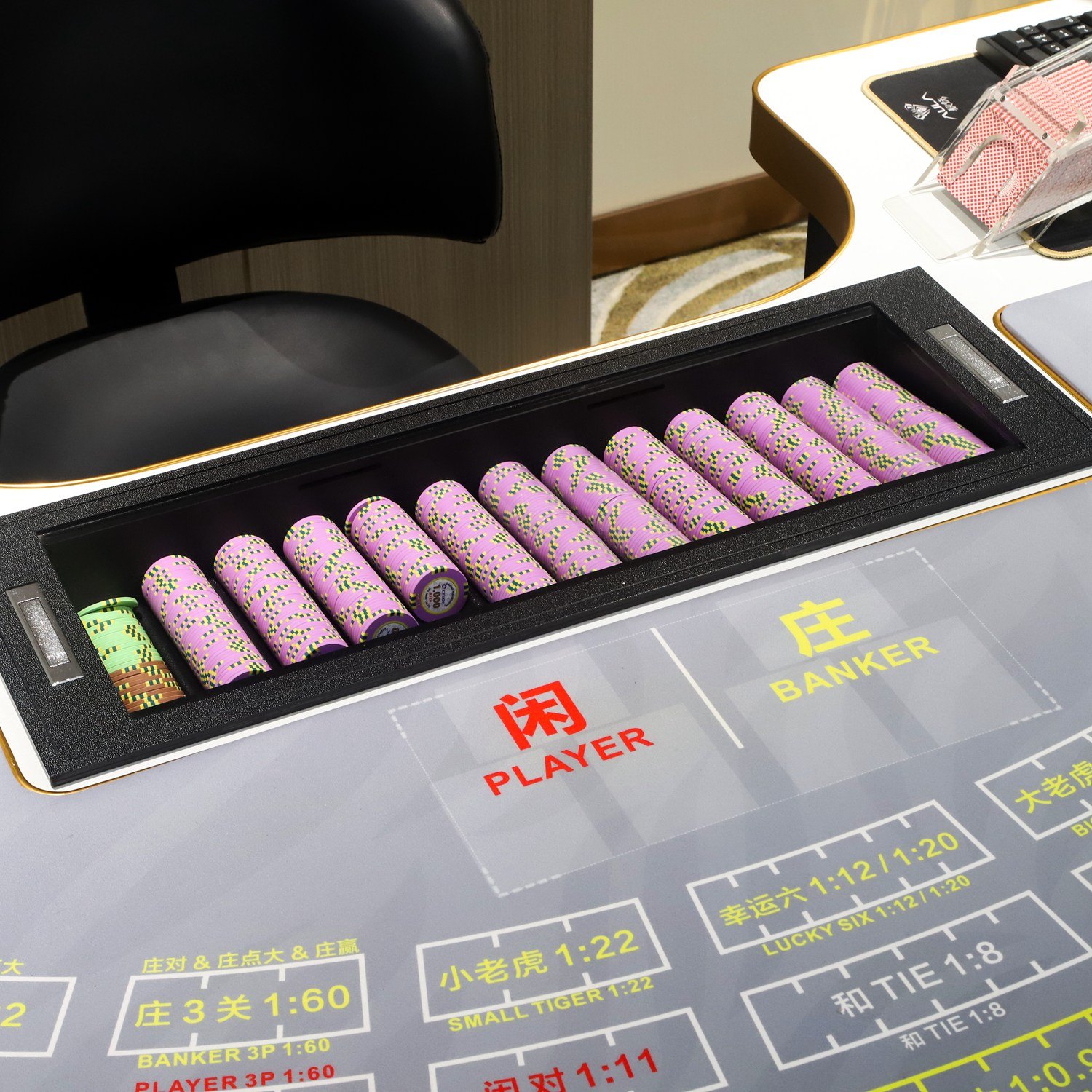
With RFID casino chips, each chip can carry a unique identification code. This allows the operator to move from basic counting toward asset-level visibility. The value is not only anti-counterfeiting. The larger value is that chip identity can be connected to table activity, cashier settlement, inventory control, and management reporting.
For example, RFID chip data can support:
- faster tray and inventory checks;
- clearer chip movement records;
- improved cashier settlement;
- better reconciliation between table and back-office data;
- reduced dependence on repeated manual counting;
- stronger support for audit and risk review.
The key point is that RFID chips alone are not the full solution. The chip only becomes truly useful when its data enters a management workflow. A casino management system provides that workflow by connecting chip recognition with table operations and back-office records.
The table is not isolated from the rest of the casino
Many casinos treat table games, cashier operations, player accounts, and reporting as separate functions. In reality, they are connected.
A player buys chips at the cage, uses them at a table, may move between tables, may be associated with a member record or junket relationship, and eventually returns chips for settlement. During that process, the casino may also need to record game activity, table limits, points, commission-related data, or risk signals.
If each department keeps its own version of the record, inconsistencies are hard to avoid. The table may have one view. The cashier may have another. The management report may be updated later. Audit teams may need to reconstruct the process after the fact.
This is why table game management needs a system-level approach.
A strong casino management system does not simply collect more data. Casinos already have plenty of data. The real value is organizing the right data into usable operational signals.
For example: 例如:
- a chip movement record should support inventory and settlement;
- a game result record should support table reporting;
- a player activity record should support account review and responsible management;
- a table status record should support floor supervision;
- an abnormal transaction signal should support risk control;
- a handover record should support accountability.
When these records are connected, management can see the casino floor as an active operating environment rather than a group of isolated tables.
Baccarat and VIP rooms make visibility even more important
In many Asian gaming markets, baccarat is not just another game. It is often one of the most important table game categories, especially in VIP and high-limit environments. Baccarat tables can involve fast rounds, large chip movement, frequent player attention to results, and strong demand for clear display information.
For operators, this makes table visibility especially important.
A busy baccarat area needs accurate result recording, clear roadmap display, controlled table limits, smooth dealer workflow, and fast supervisor review. In VIP environments, the need for accuracy is even higher because a small record gap can involve significant value.
A management system can help by connecting several parts of the operation
- table activity monitoring;
- RFID chip tracking;
- AI-assisted game recognition;
- result verification;
- player account records;
- commission and settlement support;
- shift reports;
- management dashboards.
The goal is not to make the table feel more mechanical. The goal is to reduce the parts of the operation that depend on delayed manual checking.
Players still experience a live table game. Dealers still deal. Supervisors still supervise. But the management layer behind the table becomes clearer and more traceable.
Good casino technology should reduce friction
One mistake in casino technology writing is to assume that more screens and more dashboards automatically mean better management. That is not true.
A useful casino management system should reduce friction, not add more work for the floor team.
If a dealer needs to perform too many extra actions, the system can slow down the game. If supervisors receive too many alerts, important signals can be ignored. If reports are too complicated, management may return to manual checking. If the system does not connect with real casino workflows, it becomes another isolated tool.
The better approach is to build technology around actual casino procedures:
- chip issuance;
- chip redemption;
- table opening;
- table closing;
- game record collection;
- player activity review;
- shift handover;
- abnormal event review;
- daily reporting;
- audit preparation.
This is where CTSOK’s system logic is relevant. CTSOK’s casino management solution is built around RFID chip identification, intelligent table management, AI visual identification, automated reconciliation, and real-time reporting. Instead of treating chips, tables, displays, and reports as separate tools, the system connects them into a more complete table game management workflow.
For casinos, that matters because operational control is not created by one device. It is created by the connection between devices, records, and management rules.
Real-time data is useful only when it supports decisions
Casinos do not need data for the sake of data. They need information that helps people act.
A table manager does not need a long report during a busy shift. They need to know which table requires attention. A cashier does not need disconnected chip records. They need settlement data that can be checked quickly. A compliance team does not need vague summaries. They need traceable records. Senior management does not need thousands of raw entries. They need clear indicators of performance, risk, and operational efficiency.
This is the practical difference between data collection and operational control.
A casino management system should help answer questions such as:
- Is the table operating within expected limits?
- Are chip records consistent with table activity?
- Are cashier and table records aligned?
- Are there unusual patterns that require review?
- Which tables are performing efficiently?
- Where is manual workload still too high?
- Can the casino complete handover and reconciliation faster?
When these questions can be answered faster, the casino gains more control over daily operations.
The future of land-based casino management is not only digital
The future of land-based casinos is not to become online casinos. Live gaming has its own value: atmosphere, trust, human interaction, physical chips, table presence, and premium player experience.
But land-based casinos cannot rely only on tradition. As digital and electronic gaming continue to grow, physical gaming venues need to become more operationally disciplined. They need better visibility, faster reconciliation, stronger chip control, and clearer reporting.
That is why casino management systems are becoming more important for table game operations.
The strongest casino floors will not simply be the ones with the most tables. They will be the ones where every table is easier to monitor, every chip movement is easier to verify, every shift is easier to reconcile, and every management decision is supported by timely information.
For operators, the real question is no longer whether casino technology is useful. The question is whether the technology is connected closely enough to the actual workflow of table games.
That is where systems built around RFID chips, intelligent table management, AI recognition, and real-time reporting can provide practical value. Not by replacing the live casino experience, but by making it more visible, more accountable, and easier to control.

Alien Mark is a humor-loving wordplay enthusiast and the creative mind behind PunEnjoy.com. With a passion for clever puns, jokes, and lighthearted laughs, Alien Mark crafts fun, family-friendly content that brings smiles to readers around the world. From witty one-liners to themed pun collections, his mission is simple: turn everyday words into extraordinary laughter.



17 thoughts on “Casino Management System for Table Games | CTSOK”