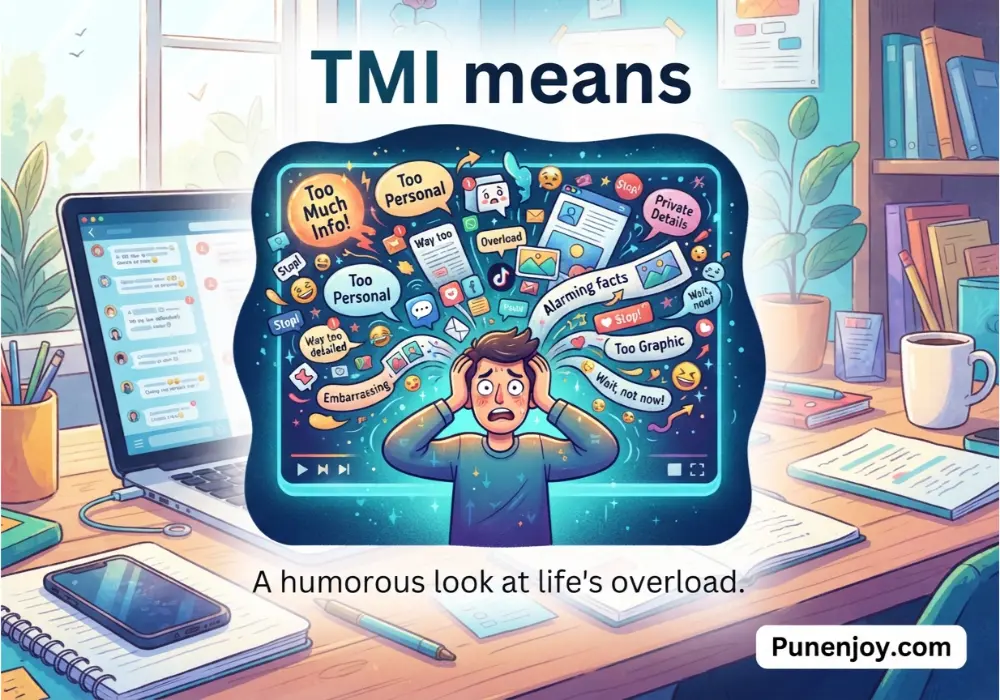
If you have seen someone type “TMI” in a text, social media comment, or group chat, you may wonder what it means. TMI means “Too Much Information.” People use this short abbreviation when someone shares more personal, private, or unnecessary information than the listener wanted to know.
TMI is common in casual online conversations. You may see it on WhatsApp, Instagram, TikTok, Snapchat, Discord, and other social platforms. Sometimes it is used seriously, but it is often playful or funny. For example, if a friend gives you far too many details about an awkward moment, you might simply reply, “TMI! 😂”
What Does TMI Mean in Text & Chat?
TMI means “Too Much Information.” In texting and online chat, it is usually used when someone gives details that feel too personal, private, awkward, or unnecessary.
The phrase does not always mean that the information is bad. Instead, it often means that the speaker has gone beyond the amount of information the listener wanted.
For example:
- Friend: “I was late because my stomach was upset all morning.”
- You: “TMI 😂”
Here, TMI is a short and humorous way of saying, “I probably did not need to know that much.”
TMI can also be used when someone talks about private subjects. These may include embarrassing moments, family issues, personal habits, dating problems, or other details that people normally keep private.
TMI can have different tones
The meaning stays the same, but the tone can change.
Funny:
“My dog ate my homework, then threw it up on my shoes. TMI? 😂”
Annoyed:
“Okay, TMI. I really didn’t need those details.”
Playful:
“TMI, bestie! 😭”
Surprised:
“Whoa… TMI!”
In most casual conversations, TMI is not meant as a serious insult. It is often a quick reaction to information that feels overly detailed.
If someone sends TMI to you, do not automatically assume they are angry. Look at the surrounding messages, emojis, and overall tone before deciding what they mean.
Full Form, Stands For & Short Meaning of TMI
The full form of TMI is “Too Much Information.”
Here is the simple breakdown:
| Term | Meaning |
|---|---|
| TMI | Too Much Information |
| T | Too |
| M | Much |
| I | Information |
| Short meaning | You shared more information than necessary |
In everyday texting, TMI is usually a reaction rather than a complete statement.
For example:
“I haven’t slept properly for three days because my neighbor snores so loudly.”
A friend might answer:
“TMI 😂”
The response means that the speaker has shared more detail than the listener wanted.
What does TMI stand for?
TMI stands for “Too Much Information.”
It is especially common in informal communication. People use it because typing three words can be faster than writing a full response.
Is TMI slang?
Yes. TMI is commonly treated as an informal internet and texting abbreviation. It is best suited to casual conversations rather than formal emails, academic writing, or professional reports.
Quick examples
- “TMI, bro 😂”
- “Okay, that’s TMI.”
- “Girl… TMI! 😭”
- “Thanks for the details, but TMI.”
- “That was definitely TMI.”
The exact feeling depends on context. A laughing emoji can make TMI sound playful, while a serious message may make it sound like a request to stop sharing personal details.
Related internal-link suggestion: Link the phrase “internet slang abbreviations” to a related page explaining common texting shortcuts.
Origin, History & First Known Use of TMI
The expression “too much information” existed long before internet slang became popular. People have always used the phrase when someone shared more information than necessary.
The abbreviation TMI became popular as a shortened form of the phrase, especially as casual communication became faster through text messaging, online forums, instant messaging, and social media.
There is no need to treat TMI as a term invented specifically for one modern social platform. Its growth is connected to a broader trend: people began shortening common phrases to make communication faster and easier.
As texting became part of everyday life, abbreviations such as LOL, BTW, FYI, IDK, and TMI became familiar to many internet users.
TMI also became popular because it is useful in humorous conversations. Someone can tell a long and awkward story, and another person can respond with just three letters:
“TMI 😂”
That short reply immediately communicates the reaction.
Why did TMI become so useful?
Digital communication has a different rhythm from face-to-face conversation. People often want to react quickly without writing a full sentence. TMI provides a simple way to signal that a conversation has become overly personal or detailed.
The term has also appeared in entertainment and popular culture, which helped make it recognizable beyond early internet communities.
Today, TMI is widely understood in casual English-language online communication.
However, the exact popularity of any slang term can change over time. Some abbreviations become less common while others return through younger users, memes, and social media trends.
In 2026, TMI remains an understandable and useful abbreviation, especially in informal texting and humorous online conversations.
How People Use TMI in Daily Conversations
People use TMI in daily conversations whenever someone shares information that feels too personal, detailed, embarrassing, or unnecessary.
The easiest way to understand it is to imagine a friend telling you a story. The first part is normal. Then the friend starts adding unnecessary personal details.
You might say:
“Okay, TMI! 😂”
It can also be used between close friends who are comfortable joking with each other.
Common situations where people use TMI
1. Personal stories
“My doctor appointment lasted two hours, and I had to talk about every little symptom.”
Response:
“TMI 😭”
2. Dating conversations
“My date told me every detail about their last relationship.”
Response:
“That sounds like TMI.”
3. Embarrassing moments
“I accidentally waved at someone who wasn’t waving at me.”
Response:
“LOL, not TMI, but definitely awkward 😂”
4. Food or health details
“I ate way too much and now I feel terrible.”
Response:
“TMI! 😂”
5. Family conversations
“My parents told me exactly what happened during their argument.”
Response:
“Whoa, TMI.”
TMI does not always mean “stop talking.” Sometimes it simply means, “That was more detail than I expected.”
The relationship between the people also matters. Close friends may use TMI as a joke, while strangers may use it more seriously.
When using TMI yourself, consider the other person’s comfort level. A playful abbreviation can still feel rude if the situation is sensitive.
TMI Meaning Across WhatsApp, Instagram, TikTok & Snapchat
The basic meaning of TMI remains “Too Much Information” across major social platforms. However, the style can change depending on the platform and conversation.
TMI on WhatsApp
WhatsApp users often use TMI in private chats and group conversations.
Example:
“Bro just told us his entire dating history 💀”
“TMI 😂”
TMI on Instagram
On Instagram, TMI can appear in comments, DMs, captions, or replies to Stories.
Example:
“My morning started with a disaster in the bathroom…”
Someone might reply:
“TMI 😭”
Instagram users may also use TMI jokingly when a caption gives unusually personal details.
TMI on TikTok
TikTok has a strong culture of storytelling, personal experiences, and humorous oversharing. TMI may appear in comments when a creator shares an especially personal detail.
Example:
“Okayyy, that was TMI 😂”
TMI on Snapchat
Snapchat conversations are usually casual and fast, so TMI can work as a quick reaction.
“I just sent you the full story.”
“TMI 😭”
Does TMI have a different meaning on each app?
Usually, no.
Across WhatsApp, Instagram, TikTok, and Snapchat:
TMI = Too Much Information.
The difference is mainly in tone and context.
A laughing emoji such as 😂 may make the abbreviation playful. An emoji such as 😭 can make it sound dramatically funny. Without an emoji, the message may sound more direct.
Different Meanings of TMI in Other Fields
Although TMI usually means “Too Much Information” in texting, abbreviations can have different meanings in specialized fields.
This is why context matters.
In casual online conversations, you should normally understand TMI as:
Too Much Information
However, in technical, business, academic, medical, or organizational settings, TMI may occasionally represent a different phrase, organization, concept, or abbreviation.
For example, an abbreviation can have different meanings depending on the industry where it appears. Someone reading a technical document should not automatically assume that every use of TMI refers to internet slang.
How can you identify the correct meaning?
Look at the surrounding words.
If someone says:
“You gave me TMI about your weekend 😂”
the meaning is clearly Too Much Information.
But if TMI appears in a professional document, report, database, product name, or technical discussion, check the context before interpreting it.
A simple rule
Casual chat + personal information = probably “Too Much Information.”
Technical or professional context = check the surrounding terminology.
This distinction is important because abbreviations are not always unique.
For everyday texting, however, there is usually little confusion. When a friend replies “TMI,” they almost certainly mean that you have shared more information than they wanted or expected.
Internal-link suggestion: Add links to related pages such as “What does FYI mean?”, “What does BTW mean?”, “What does IDK mean?”, and “What does LOL mean?”
Common Confusions, Mistakes & Wrong Interpretations
One common mistake is assuming that TMI always means the other person is angry. That is not necessarily true.
TMI is often used as a joke.
For example:
“My brother spent 45 minutes explaining why his sandwich was perfect.”
“TMI 😂”
The speaker may simply be teasing.
Another mistake is thinking that TMI means the information is false. It does not. TMI says nothing about whether the information is true or untrue.
Common misunderstandings
Mistake 1: Thinking TMI means “I don’t believe you.”
It does not.
Mistake 2: Thinking TMI is always rude.
It can be rude in some situations, but friends often use it playfully.
Mistake 3: Assuming TMI always means private information.
Not necessarily. It can also describe too many unnecessary details about an ordinary topic.
Mistake 4: Using TMI in formal writing.
TMI is informal slang. A professional email would usually be better with a clear sentence such as, “That’s more detail than necessary.”
Mistake 5: Ignoring tone.
The same “TMI” can feel friendly or harsh depending on the conversation.
Compare:
“TMI 😂”
with:
“TMI. Please don’t share personal information like that.”
The first sounds playful. The second is a clear boundary.
Quick tip
Before reacting to TMI, look at:
- The relationship between the people
- The previous messages
- Emojis
- The subject being discussed
- Whether the person is joking or serious
Context usually tells you what the sender intended.
Similar Terms, Alternatives & Related Slang
TMI belongs to a large group of internet expressions used to describe reactions, information, or social situations.
Here are some related expressions:
Oversharing
Oversharing means giving more personal information than people normally expect.
Example:
“He started oversharing about his personal life.”
Too Much Detail
This is a direct alternative to TMI.
“Okay, that’s too much detail.”
You Didn’t Need to Tell Me That
This phrase has a similar meaning but sounds more conversational.
“You really didn’t need to tell me that 😂”
That’s Personal
This can be used when someone asks or shares something private.
“Whoa, that’s personal.”
Way Too Much Information
This is a longer version of the same idea.
“That’s way too much information!”
Related texting abbreviations
TMI is often used alongside other common abbreviations:
- LOL — Laughing Out Loud
- BTW — By The Way
- FYI — For Your Information
- IDK — I Don’t Know
- IMO — In My Opinion
- TBH — To Be Honest
- OMG — Oh My God
Internal-linking opportunity: Create a cluster of abbreviation pages and link TMI to related pages such as LOL meaning, FYI meaning, TBH meaning, and IDK meaning.
These links can help readers move between related slang topics while also making the site easier to navigate.
Examples of TMI in Real Chat Situations
The easiest way to understand TMI is to see how people use it naturally.
Example 1: Funny story
Alex: “I fell asleep during the movie and woke up with popcorn everywhere.”
Sam: “TMI 😂”
Here, Sam is joking about Alex’s unnecessary detail.
Example 2: Personal information
Mia: “My parents were arguing last night, and they told me everything about their relationship problems.”
Sara: “Whoa, TMI.”
Here, the reaction is more serious because the topic is personal.
Example 3: Food
Jake: “I ate six slices of pizza and now I regret everything.”
Chris: “TMI bro 😭”
This is playful.
Example 4: Dating
Emma: “My friend told me every detail about her first date.”
Lily: “Okay, TMI 😂”
Example 5: Group chat
Noah: “Guys, I just woke up and my hair looks absolutely crazy.”
Ryan: “That’s not TMI. Send a picture 😂”
This example shows that not every personal comment is TMI.
More quick examples
- “TMI, I didn’t need that image in my head 😂”
- “Okay, TMI bestie!”
- “Bro… TMI 😭”
- “That’s definitely TMI.”
- “You are oversharing. TMI!”
- “LOL, TMI but I respect the honesty.”
- “TMI warning next time 😂”
The phrase is flexible, which is one reason it remains useful in casual online conversations.
How to Reply When Someone Says TMI
If someone says TMI after you share something, the best response depends on the situation.
If they are clearly joking, you can respond with humor.
Funny replies
“You asked! 😂”
“Too late now 😭”
“No refunds on information!”
“My bad 😂”
“You wanted the full story!”
Casual replies
“Haha, fair enough.”
“Okay, I’ll stop there.”
“Got it 😂”
“I probably gave too many details.”
If the conversation is sensitive
If someone genuinely seems uncomfortable, it is better to respect the boundary.
You could say:
“Sorry, I didn’t mean to overshare.”
Or:
“My bad. I won’t go into more detail.”
If you want to tease a friend
“TMI? You were listening the whole time 😂”
“Don’t act like you weren’t curious!”
The key is to read the tone.
If the person sends “TMI 😂”, they are probably joking. If they simply say “TMI” after a sensitive topic, they may want you to stop or change the subject.
When in doubt, a simple response like “Haha, my bad” is usually safe and friendly.
Is TMI Still Popular? Trends & Online Usage
TMI remains a recognizable internet abbreviation in 2026, especially among people who use casual English texting and social media.
However, online slang changes quickly. New expressions appear, older abbreviations become less common, and some terms return through memes or younger online communities.
TMI has an advantage because its meaning is easy to understand. The phrase “too much information” is useful in many situations, so the abbreviation can still work even when someone does not use it every day.
You may see TMI in:
- Text messages
- Group chats
- Social media comments
- TikTok discussions
- Instagram DMs
- Snapchat messages
- Online forums
- Meme conversations
- Casual gaming chats
Its tone has also become flexible. It can be funny, sarcastic, surprised, or serious depending on the conversation.
For example:
“TMI 😂”
usually feels very different from:
“That’s TMI. Please don’t share that.”
The first is likely playful. The second communicates a boundary.
Is TMI outdated?
Not really. It may not be the newest slang phrase, but being an older abbreviation does not make it meaningless. Common abbreviations often remain useful because people understand them quickly.
In 2026, TMI is best viewed as a well-known casual abbreviation, rather than a brand-new slang trend.
Its continued usefulness comes from a simple idea: sometimes people really do share more information than everyone else wanted to hear. 😅
FAQs:
What does TMI mean in texting?
TMI means “Too Much Information.” People use it when someone shares more personal, private, embarrassing, or unnecessary information than expected.
What does TMI stand for?
TMI stands for “Too Much Information.” It is a common informal abbreviation used in texting and online conversations.
Is TMI a bad word?
No. TMI is not a bad word or swear word. It is an informal expression used to react to oversharing or unnecessary details.
What does TMI mean from a girl?
If a girl says “TMI,” she usually means that you shared more information than she wanted or expected. Depending on the conversation, she may be joking or genuinely asking you to stop sharing details.
What does TMI mean from a guy?
If a guy says “TMI,” the meaning is usually the same: “Too Much Information.” His tone may be playful, surprised, or serious depending on the context.
Can TMI be used as a joke?
Yes. TMI is very often used humorously, especially between friends.
Example:
“I ate so much at lunch that I can’t move 😂”
“TMI!”
Is TMI used on social media?
Yes. TMI can appear on platforms such as Instagram, TikTok, Snapchat, WhatsApp, and other online communities.
What is another way to say TMI?
You can say:
- “That’s too much information.”
- “You’re oversharing.”
- “I didn’t need to know that.”
- “That’s a little too personal.”
- “Way too much detail!”
Is TMI still used in 2026?
Yes. TMI remains a recognizable informal abbreviation in English-language digital communication, although slang popularity can vary between online communities.
Conclusion:
So, what does TMI mean? In texting and online conversations, TMI means “Too Much Information.” It is used when someone shares more details than another person expected, wanted, or needed.
TMI can be funny, playful, awkward, or serious depending on the situation. You may see it in WhatsApp messages, Instagram comments, TikTok discussions, Snapchat chats, group conversations, and other casual online spaces.
The best way to understand TMI is to look at the context. An emoji such as 😂 or 😭 can make it sound like a joke, while a short and serious “TMI” may signal that someone feels uncomfortable

Sergey Sokolov specializes in writing about meaning, definitions, and conceptual understanding. His work aims to break down ideas into simple explanations, helping readers grasp not just what something means, but why it matters. Sergey’s writing combines clarity, logic, and insight.


2 thoughts on “TMI Means in Text & Cha Full Form Meaning Examples”